
Part of the VA loans in Arizona guide, where every rule on this page is cited and dated.
Most veterans use their VA benefit once, on a single-family house, and never think about it again. That is a reasonable life decision and it leaves an enormous amount on the table.
The VA loan will finance up to four units with no down payment, provided you live in one of them. That one sentence is the foundation of the most powerful wealth-building tool available to anyone who has served, and almost nobody explains it.
Here is the whole play, the arithmetic, and an honest account of what breaks it.
The structure
A fourplex has four units. You occupy one. You rent the other three.
The tenants in those three units pay most of your mortgage. You live in a property worth four times what you could otherwise afford, with nothing down, no monthly mortgage insurance, and a note that somebody can assume from you later.
Then after a couple of years you refinance out of the VA loan into conventional financing, which restores your entitlement, and you do it again on a second fourplex.
The math on the first one
Illustrative, using a Phoenix metro fourplex. These are assumptions to show the mechanism, not a quote and not a prediction.
| Purchase price | $900,000 |
| Down payment | $0 |
| Funding fee, financed | roughly $19,350 at a first-use, zero-down rate |
| Loan amount | about $919,350 |
| Principal and interest at 6.5% over 30 years | about $5,810 |
| Taxes and insurance | about $825 |
| Total monthly payment | about $6,635 |
| Three units rented at $1,600 | $4,800 |
| Your actual housing cost | about $1,835 a month |
Read the last line again. You are living in a $900,000 asset for less than a decent two-bedroom rental costs in this market, and the tenants are paying down your principal every month.
That is the entire idea. Everything after this is repetition.
The sequence over ten years
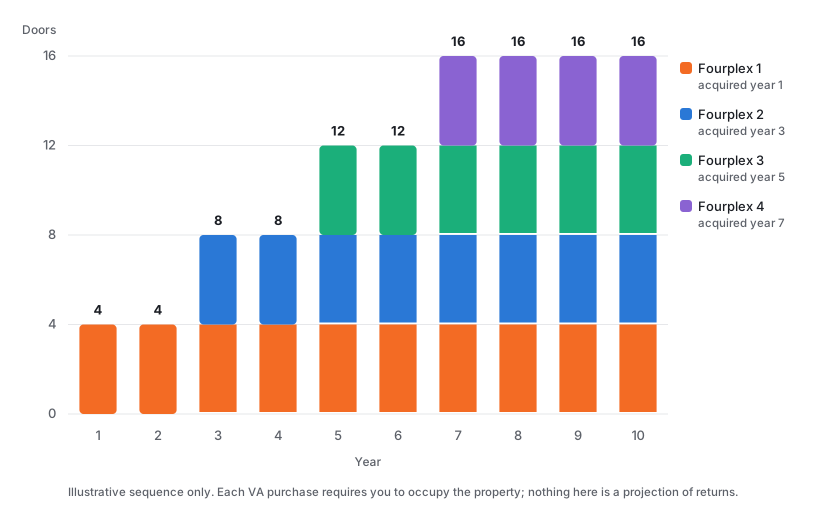
Roughly a two-year cycle. Buy, occupy, let the rents season, refinance into conventional financing so the VA loan is paid off and the entitlement comes back, move into the next one, repeat.
Four properties, sixteen doors, inside a decade. Then you stop, keep fifteen rented units throwing off income, and go buy the house you actually want to live in.
Why conventional on the refinance? Because the VA loan requires you to occupy. Once you move out, you are no longer eligible to keep that property on VA financing indefinitely, and conventional investment financing is the correct home for an asset you no longer live in. The refinance also pays off the VA loan, which is what frees the entitlement.
Why this beats almost every other strategy
No down payment. A conventional investor buying the same fourplex would need a substantial amount down. You need none. That is years of saving you simply skip, four times over.
No monthly mortgage insurance. FHA would charge it for the life of most loans. Conventional charges it under twenty percent down. VA charges none, ever.
The rents help you qualify. Not just pay the bill. On a multi-unit purchase the income from the other units can count toward qualifying, which is what lets a borrower with an ordinary income buy a property at this price.
Residual income, not just ratio. VA applies a test no other program uses, looking at what is actually left over each month after everything is paid, scaled to family size. For a veteran with rental income coming in, that test is frequently kinder than a pure debt-to-income calculation.
The note is assumable. If you keep one of these long term, a below-market rate becomes a genuine asset when you eventually sell. See Your VA Loan Is Assumable.
The four things that break this
I am not going to sell you the version where this always works. Here is what actually goes wrong.
1. You have to move. Four times. The occupancy requirement is not a formality, and it is the real cost of this strategy. Every purchase means relocating your household into a unit of a building you just bought. If you have a family settled in a school, that is a serious conversation and sometimes the answer is no. This plan is far easier at 26 than at 46.
2. The rents might not cover it. My table assumed three units at $1,600 and full occupancy. Reality brings vacancy between tenants, a tenant who stops paying, turnover costs, and the capital expenses nobody budgets for. A roof, two air conditioners and a sewer line on a sixteen-unit portfolio are not hypothetical, they are a Tuesday. Underwrite every one of these assuming a vacant unit and a repair, not a full house and a quiet year.
3. The refinance has to be available. Refinancing a four-unit investment property is a different proposition from refinancing a house. The loan-to-value limits are lower, the pricing is higher, and the property's income has to support it. If values have not moved and rates are higher than when you bought, the refinance that frees your entitlement may not be there when you want it. A strategy that only works if you can refinance is a strategy that has not planned for rates staying put.
4. Sixteen doors is a business. Not passive income. It is leases, maintenance calls, turnovers, bookkeeping, fair housing compliance and the occasional eviction. You either do that work or you pay a manager eight to ten percent of gross to do it, which has to be in your numbers from the first property.
What to actually do
Get your Certificate of Eligibility and find out what your entitlement supports. Everything starts here and it takes very little time.
Run the first property's real numbers, with a real rent estimate from somebody who manages in that submarket, real taxes, real insurance, and a vacancy allowance. Not my illustrative table. Yours.
Check the funding fee. If you have a service-connected disability rating you may be exempt entirely, which changes the arithmetic on every one of these.
Confirm your credit position early, because the VA sets no minimum score and your lender absolutely does.
Buy the first one and live in it for the required period before you plan the second. The single most common way this fails is a veteran planning four purchases before completing one.
The honest summary
The mechanism is real, it is written into the program, and it is available to anyone with entitlement and the willingness to move a few times. Veterans do build substantial portfolios this way.
It is not passive, it is not guaranteed, and it depends on rents, values and refinance availability that nobody controls. Anyone presenting this as certain wealth is selling something.
What I will do is run your actual numbers on an actual building and tell you whether the first one works. That is the only part that matters right now.
Why bring a VA file to us
- We quote the rule and the overlay separately. VA sets the floor. Your lender sets what they will actually do. Those are different numbers and only one of them decides your file.
- Broker model. When a lender's overlay is the obstacle rather than VA's rule, the fix is moving the file, not fixing you.
- We do not treat the VA loan as the fallback. No down payment, no monthly mortgage insurance and an assumable note is the strongest financing available to most buyers who have earned it.
- You talk to the principal. Ricky Khamis is President of EPiQ Lending, NMLS #173141, lending in Arizona since 1999 and a 2025 Presidents Club Winner at CMG Home Loans. Direct line: (480) 999-9842.
EPiQ Lending is NMLS #1936984, at 7975 N. Hayden Road, Suite A-101 in Scottsdale. Verify all of it before you trust any of it: Ricky's EPiQ Lending profile, the Scottsdale branch, and the license itself at NMLS Consumer Access. Hold every lender to that standard, including us.
Send me your Certificate of Eligibility, or let me pull it, and I will tell you what your entitlement actually supports.
Equal Housing Opportunity. This is general information, not a commitment to lend or an offer to extend credit. The VA home loan program is administered by the U.S. Department of Veterans Affairs; loans are made by private lenders, not by the VA, and this site is not endorsed by or affiliated with the VA or any government agency. Eligibility, entitlement, funding fee amounts and exemptions are determined by the VA based on your service record and disability status. Program requirements are set out in the VA Lenders Handbook and change over time, and individual lenders routinely impose requirements stricter than the VA's published minimums. Any figures shown are illustrative, are not a quote, and are not a projection of investment returns. Rental income, property appreciation and refinancing availability are not guaranteed. Rates, terms and program guidelines change and depend on credit approval, property appraisal and other qualifying factors. Not all applicants will qualify. This is not legal, tax or investment advice.
Looking at a specific home? Send me the address and I will run the numbers: rickykhamis.com/analyze