
You are not losing buyers to the house down the street. You are losing them to the builder's lender, and to a first-year payment you did not know you could match.
Builders have been buying rates down for two years. They have the margin, they have a captive lender, and they advertise the result as a rate rather than a discount. A buyer walks your open house, then walks a model home, and the model home comes with a number in the fives. Your listing comes with a number near seven.
That gap is matchable. Not with a price cut. With the same money pointed at the rate instead, locked at your property before you list, and advertised in your remarks exactly the way the builder advertises theirs.
Why cutting your price loses this fight
A price reduction lowers the buyer's loan balance. A buydown lowers their rate, which applies to the whole balance for the life of the loan, or for the years that matter most.
Dollar for dollar, the rate is the stronger lever. That is not a sales argument, it is arithmetic. And more importantly: the builder is advertising a rate, so a rate is what you have to answer with. A price cut does not show up on the flyer the buyer is comparing you against.
This is not anecdotal. Per Realtor.com, nearly one in five newly built homes advertises a buyer incentive up front, and the most common incentive is a reduced rate.
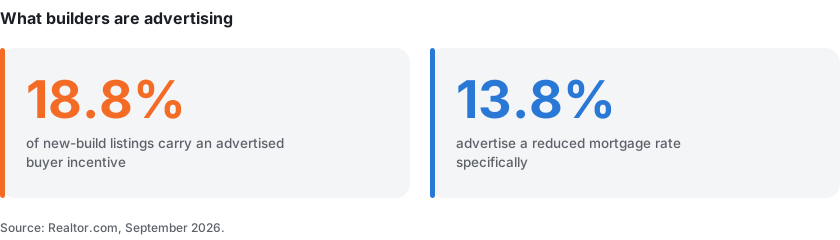
Builders can do this because they have the margin, a captive lender, and a reason to move inventory this quarter. It is working. Logan Mohtashami, Chief Economist at HousingWire, has pointed out that new-home sales have been running near 2019 levels while existing-home sales sit roughly a million short of them. Robert Dietz, Chief Economist at the National Association of Home Builders, put the pressure on resale sellers plainly: existing homeowners now have to do the price discovery that builders have been doing since 2022.
Meanwhile the resale market is reaching for the wrong tool. 20.8% of active listings carried a price cut in September, the highest September share since 2018. Inventory rose 5.4% year over year while homes under contract fell 4.1%. More sellers are cutting, and it is not restarting demand.
Meanwhile Freddie Mac's Primary Mortgage Market Survey put the 30-year fixed average at 7.03 percent on September 24, 2026, up from 6.95 the week prior, with daily trackers running higher into month end.
So the buyer's problem is the payment. Answer the payment.
What the structures actually do
A temporary buydown works by escrowing money at closing that subsidizes the buyer's payment for a set period. The note rate does not change. The buyer's effective rate in the early years does.
The 3-2-1. Three percentage points below the note rate in year one, two points in year two, one point in year three, then the note rate from year four on.
The 2-1. Two points below in year one, one point below in year two, then the note rate.
The 1-0. One point below in year one only.
Here is what that means in practice. Work from a note rate in the high sevens, which is roughly where a conventional thirty year has been sitting:
| Structure | Year 1 | Year 2 | Year 3 | Year 4+ |
|---|---|---|---|---|
| 3-2-1 | ~4.75 | ~5.75 | ~6.75 | note rate |
| 2-1 | ~5.75 | ~6.75 | note rate | note rate |
| 1-0 | ~6.75 | note rate | note rate | note rate |
Illustrative only, derived from the structure applied to an assumed note rate. Your buyer's actual note rate depends on their credit, loan program, occupancy, loan amount, down payment and market pricing on the day they lock.
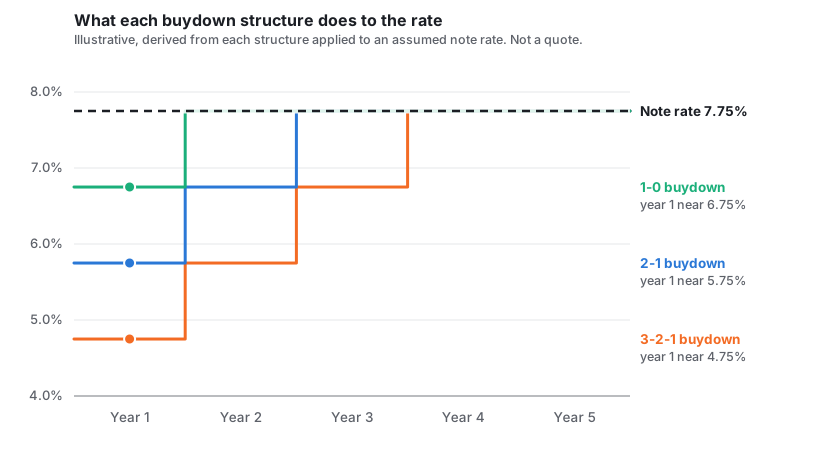
A note on the assumption. The table and chart work from a note rate near 7.75, which is closer to what a real file prices at than the survey average. Freddie Mac's survey number reflects a specific profile: conforming balance, strong credit, substantial down payment. An actual quote moves with the borrower's program, credit, occupancy and loan size, and on most of the files I see it runs above the headline. Use the structure, not my assumed starting point, and have the real one run on the real buyer.
A first year in the fours. That is the number that competes with the model home, and it is produced by money you were probably about to take off your price anyway.
What it costs, and who pays
The cost of a temporary buydown is simply the total of the payment subsidies over the buydown period, escrowed up front. A 3-2-1 subsidizes more, for longer, so it costs more than a 2-1, which costs more than a 1-0.
As a rough shape: a 2-1 commonly runs a low single digit percentage of the loan amount, and a 3-2-1 meaningfully more. Get the exact figure quoted on the actual loan rather than working from a rule of thumb, because it moves with the rate and the loan size.
A permanent buydown is the other option. Discount points paid at closing lower the note rate for the entire life of the loan. No step-ups, no expiry. For a buyer who intends to stay, this is often the better use of the same money, and it is worth running both.
And the detail that kills deals when nobody checks it: concession limits are capped, and the cap is not the same for every buyer.
| Loan type | Commonly permitted seller contribution |
|---|---|
| Conventional, primary or second home | 3% at high loan-to-value, rising to 6% and then 9% as the down payment grows |
| Conventional, investment property | 2% |
| FHA | 6% |
| VA | 4% for seller concessions, with its own definition of what counts |
| USDA | 6% |
Those tiers change, and the detail matters, so confirm the limit against the buyer's specific loan before you offer anything. This is the single most common way a generous seller offer gets restructured a week before closing: the concession exceeded what the program allows, and the excess simply cannot be used.
A 3-2-1 on a low down payment conventional loan can easily exceed the cap. A 2-1 usually fits. That is often the real reason to choose one over the other, not preference.
How to put it in front of buyers
The builder advertises a rate. You should too.
Work it into the listing remarks and the marketing, not just into a counteroffer. "Seller offering a 2-1 buydown" is a headline. "Seller will consider concessions" is wallpaper that every listing says.
Give agents the actual number. An agent who can tell a buyer "your first year is in the fives here" will bring that buyer. An agent holding a vague concession offer will not, because they cannot do the math standing in your kitchen.
And answer the builder on their own terms. Joel Berner, Senior Economist at Realtor.com, makes the point that resale sellers should lead with what the neighborhood offers against the more suburban and exurban locations where most new construction gets built. That is true, and it is only half of it. Location is your structural advantage. The buydown is how you stop losing on payment while you make the location argument.
Have a lender run it before you list, so the figure in your marketing is real and defensible rather than a hope. That is the entire design of List & Lock: the rate is locked at the property before the sign goes in the yard, so the number in your remarks is a locked rate rather than a maybe.
One honest caution, and it is the limitation that matters most: on a standard temporary buydown the buyer generally still has to qualify at the note rate, not the subsidized rate. The buydown lowers the payment they make. It does not usually lower the payment they are underwritten against. A buyer who cannot afford the house at the note rate is not helped into it by a 3-2-1, and should not be.
That single constraint is why a lot of sellers offer a buydown and still lose the buyer. The payment got better. The approval did not.
List & Lock, and why it is a different animal
There is a version of this that removes that constraint, and it is the one I use.
List & Lock is an EPiQ Lending program built for exactly this problem. The sequence runs backwards from a normal concession:
- You decide what you are willing to contribute toward a lower rate, before you list.
- The rate gets locked, at your property, at a discount to the market.
- You advertise that rate in your listing, the same way the builder down the street advertises theirs.
- The lock transfers to your buyer when they go under contract.
The difference that matters:
| Standard temporary buydown | List & Lock | |
|---|---|---|
| Buyer's payment | Reduced in the early years | Reduced |
| Buyer qualifies at | Generally the note rate | The List & Lock rate |
| Advertisable before an offer | Not really | Yes, it is the point |
| When it is arranged | In negotiation, after an offer | Before you list |
Buyers qualify on the List & Lock rate rather than the market rate. That is not a payment improvement, it is a qualifying improvement, and it widens the pool of buyers who can actually get approved on your house rather than just the pool who like the payment.
It works across Conventional, VA and select adjustable-rate products, so it is not a narrow niche tool.
Two things to know before you plan around it. The lock is tied to your property and cannot be moved to a different address, so it is a commitment to the listing rather than a portable asset. And it is not a guarantee to lend: your buyer still has to qualify, underwrite and close like any other borrower, and the program is subject to its own terms.
One more piece worth knowing if you are selling to buy: sellers who use List & Lock are eligible to receive up to $5,000 back toward closing costs on their next purchase loan with EPiQ, subject to program terms. If you are moving up or moving across town, that is real money on the other side of the transaction.
The four questions to ask before you reduce
Ask your lender, not just your agent:
- What does a price reduction of a given amount do to the buyer's monthly payment?
- What does that identical amount do as a 2-1 or 3-2-1 buydown?
- What is the maximum concession the buyer's loan type actually permits?
- For this buyer, is a permanent buydown the better use of the money than a temporary one?
- Can we lock the rate at the property before listing, so the buyer qualifies on it rather than on the market rate?
Most sellers never ask any of them, and reduce instead. That is the opening.
Send me the buyer's loan type and the amount you are considering taking off your price, and I will run all four before your seller signs a reduction. It takes about ten minutes.
While you are at it
Make the house easy to finance. A deferred roof, an unpermitted addition, a condominium project with thin reserves or an association in litigation can all narrow the pool of buyers who can get a loan on your property at all. In Scottsdale, project eligibility quietly disqualifies more buyers than price does. See Scottsdale Luxury Condo Financing.
If you are buying next, get underwritten before you list. With pendings down and inventory up, a seller who is also a buyer has leverage on the purchase side, and it disappears if your offer depends on a sale you have not structured.
Ricky Khamis is President of EPiQ Lending, NMLS #173141, lending in Arizona since 1999 and a 2025 Presidents Club Winner at CMG Home Loans. Direct line: (480) 999-9842. EPiQ Lending is NMLS #1936984, at 7975 N. Hayden Road, Suite A-101 in Scottsdale.
Verify all of it before you trust any of it: Ricky's EPiQ Lending profile, the Scottsdale branch, and the license itself at NMLS Consumer Access.
List & Lock is an EPiQ Lending program. Participation is subject to program terms and eligibility; the rate lock is tied to a specific property address and cannot be transferred to another address; and the program is not a guarantee to lend. Buyers must still qualify, and closing is subject to credit approval, underwriting and property eligibility. The closing cost benefit on a subsequent purchase is subject to program terms and conditions. Buydown structures and the figures in the table above are illustrative, derived from the structure applied to an assumed note rate, and are not an offer or a quote. Actual rates depend on credit approval, loan program, occupancy, loan amount, down payment, property type and market pricing at lock. Seller contribution limits vary by loan type, occupancy and loan-to-value and change over time; confirm current limits against the buyer's specific loan. Market figures are from Freddie Mac's Primary Mortgage Market Survey dated September 24, 2026 and the Realtor.com September 2026 housing report; market data changes continuously.
Equal Housing Opportunity. This is general information, not a commitment to lend or an offer to extend credit. Rates, terms, and program guidelines change and depend on credit approval, property appraisal, and other qualifying factors. Not all applicants will qualify.
Looking at a specific home? Send me the address and I will run the numbers: rickykhamis.com/analyze